
May 2026, and the AI energy story still revolves around three narratives: nuclear, natural gas, and solar-wind. As hyperscalers accelerate their quest for clean energy to meet carbon-zero targets, the market typically discusses Amazon's $650 million nuclear deal with Talen Energy or Microsoft's renewed investments in natural gas plants. Solar and wind remain the mainstream of renewable energy due to their low costs. But between these three options lies an overlooked, technically unique alternative: geothermal energy.
Unlike solar and wind, geothermal generates electricity 24/7 without interruption, requires no battery storage, and operates at capacity factors between 66-91%. For AI data centers, this is a critical advantage. Data center operators aren't just seeking "clean" energy—they need "reliable and uninterrupted" power. Solar and wind cannot meet this need without expensive battery storage; nuclear offers ideal baseload but faces 10+ year permitting processes and social acceptance challenges. Geothermal becomes strategic precisely here: combining nuclear's continuity with solar-wind's clean energy promise, while offering a speed and scalability potential neither possesses.
But this doesn't mean geothermal is a guaranteed winner. Geothermal struggles with high upfront capital (CAPEX), geological uncertainty, drilling failure risks, and 5+ year development timelines. Therefore "strong geothermal theme" doesn't equal "good geothermal stock." The investor question: If geothermal truly becomes a strategic 24/7 clean power solution in the AI age, where does economic value accumulate? In geothermal energy producers, or in the narrow players within the supply chain—drilling services, ORC equipment, premium tubular suppliers?
This piece centers on that tension, examining geothermal's technical foundation, AI data center connection, US-listed companies, critical supply chain components, oligopoly structures, time horizons, and key risks.
What Is Geothermal, Really?
When people hear "geothermal energy," they typically think of hot water sources in volcanic regions. This describes classical geothermal or hydrothermal systems, where natural fractures and permeable rocks allow hot water to accumulate in near-surface reservoirs. Water is pumped, electricity generated, and water returned underground. Companies like Ormat Technologies operate primarily on this principle. But classical geothermal is geographically constrained—economically viable only in volcanic zones.
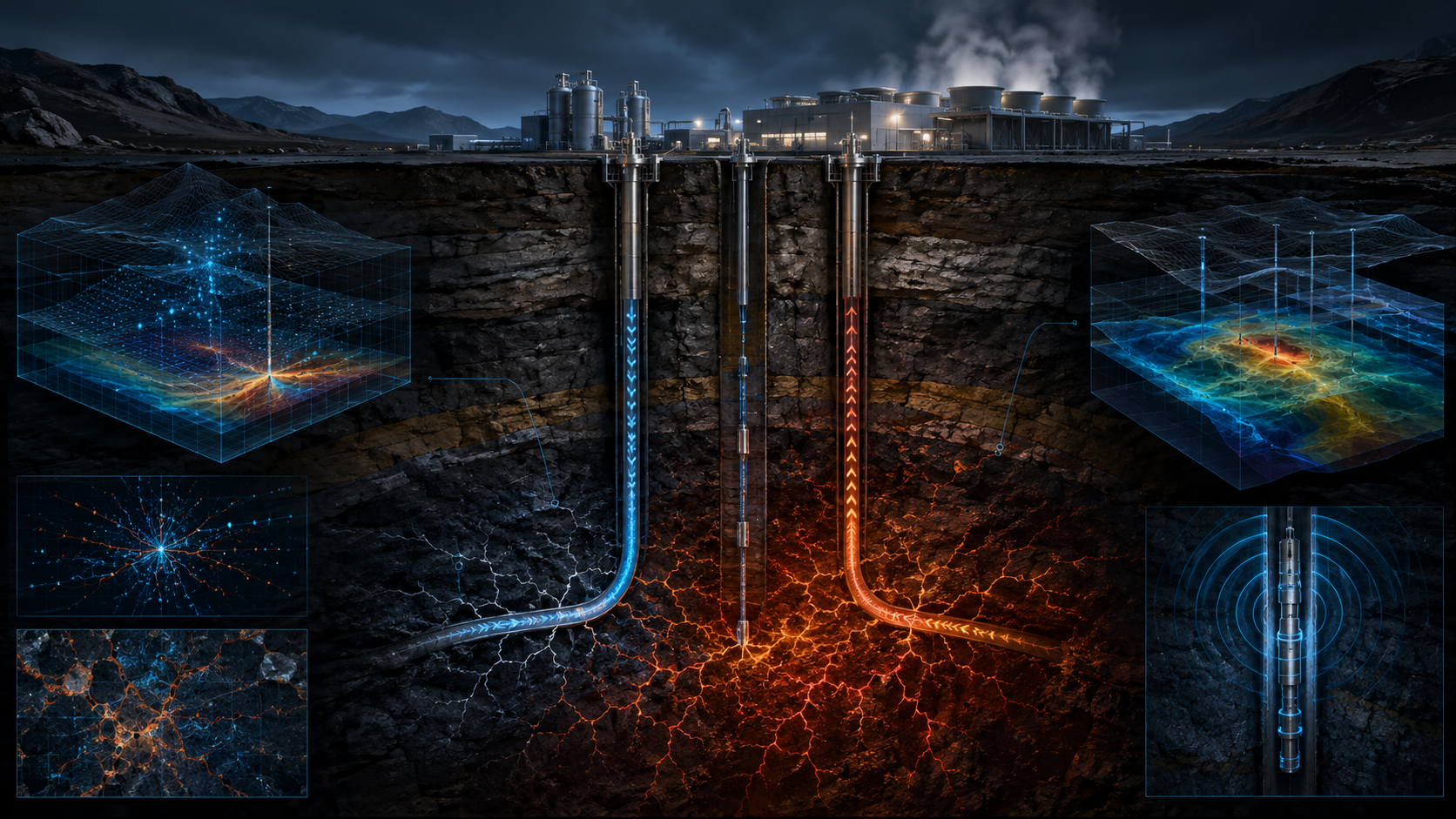
Enter Enhanced Geothermal Systems (EGS). EGS promises to liberate geothermal from geographical constraints by creating artificial reservoirs in dry hot rocks in non-volcanic areas. The process: drill 3-10 km deep, use hydraulic stimulation (fracking-like) to create fracture networks in rocks, inject water to heat it, extract heated water to surface for electricity generation, and return water underground. EGS's biggest promise: transforming geothermal from a geologically limited resource into a globally accessible energy source. Fervo Energy's Google-backed Nevada pilot project relies precisely on this technology.
Closed-loop geothermal offers a different approach altogether. These systems don't touch groundwater; instead, they circulate working fluid in a closed loop to extract heat. GreenFire Energy's GreenLoop® technology and Eavor's closed-loop solutions aim for more sustainable long-term energy production by preserving reservoir mass and pressure. However, these technologies haven't yet scaled commercially, and no US-listed public companies provide direct exposure to this space.
Geothermal's technical heart lies in Binary Cycle or Organic Rankine Cycle (ORC) systems. ORC converts low-to-medium temperature geothermal sources into electricity using an organic working fluid with a lower boiling point than water. This fluid vaporizes from geothermal fluid heat, spins a turbine to generate electricity, condenses, and repeats the cycle. Ormat Technologies has 30+ years of experience in this technology and leads globally with 192 patents. Companies like ElectraTherm offer ORC solutions operating at temperatures as low as 70°C, converting industrial waste heat into electricity.
How does geothermal differ from solar and wind? Here's the critical distinction: Geothermal produces electricity 24/7 without intermittency. Solar stops at night; wind turbines halt on windless days. Battery storage partially solves this but adds cost and has limited discharge duration. Geothermal operates at 66-91% capacity factors—approaching nuclear's levels and far exceeding solar (~25%) and wind (~35%). Thus geothermal is the only renewable energy source providing baseload capacity. For AI data centers, this difference is vital.
Why Does This Matter for AI Data Centers?
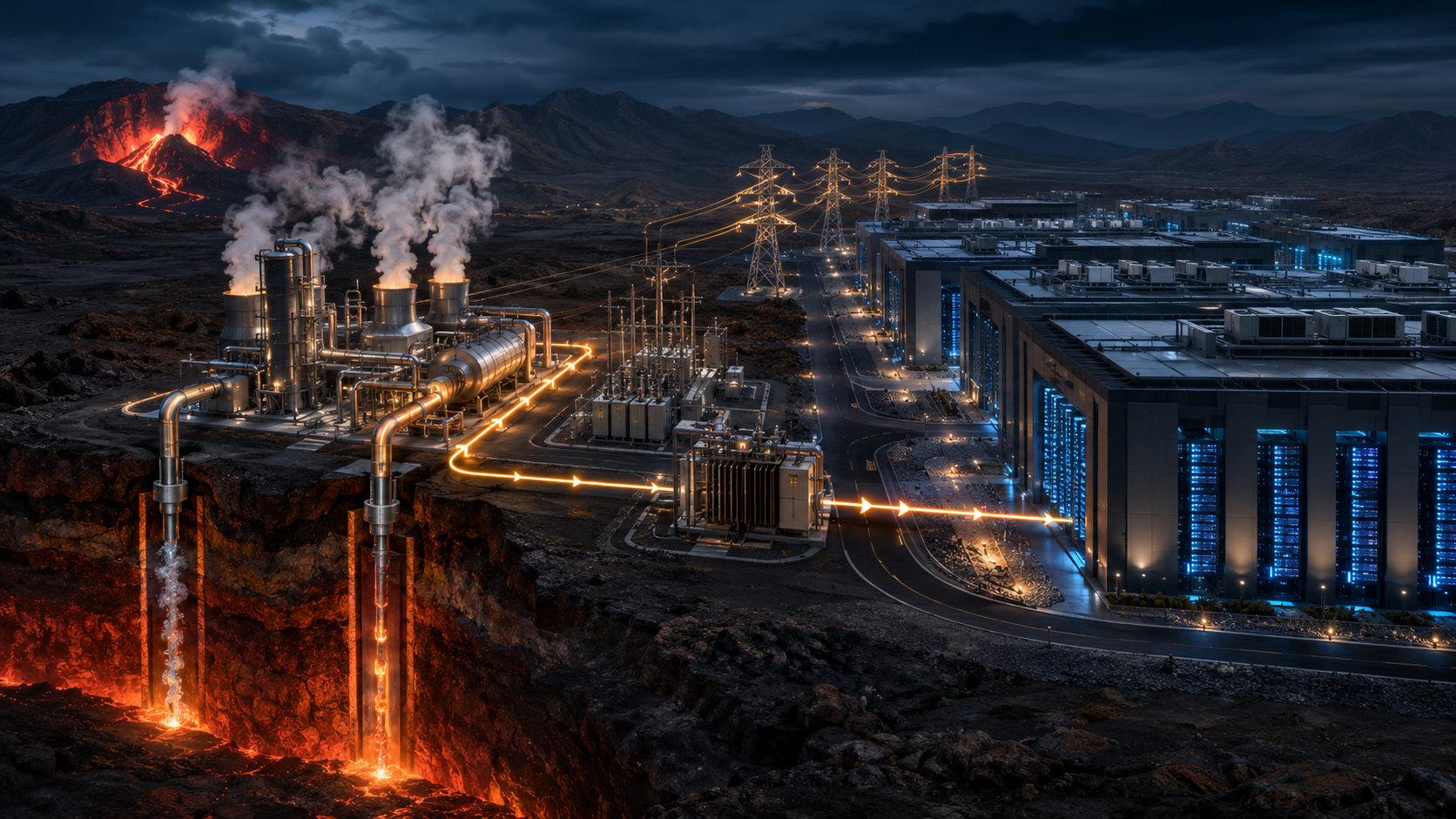
AI data centers demand uninterrupted, clean, and reliable energy. Training and running large language models like ChatGPT, Gemini, and Claude requires GPU clusters operating 24/7 without pause. Power outages represent unacceptable risk for data center operators. Therefore hyperscalers aren't just seeking "renewable energy"—they need "renewable + reliable + uninterrupted" energy.
Solar and wind alone cannot meet this need. Battery storage partially addresses this but costs matter: grid-scale battery storage can become more expensive per kWh than continuous baseload sources like geothermal or nuclear. Moreover, batteries have limited energy density; meeting large data centers' multi-day energy needs requires massive storage capacity.
Geothermal enters precisely here: 24/7 clean baseload with zero battery storage requirements. Google, Microsoft, Meta, and Amazon are paying attention. In February 2026, Google signed a deal with Ormat Technologies for up to 150 MW of geothermal electricity for Nevada data centers—a critical piece of Google's carbon-zero strategy. Ormat's stock rose 8.1% after the announcement; the market began pricing geothermal's AI data center connection.
Google isn't just partnering with Ormat. It also developed the first EGS pilot project in Nevada with Fervo Energy. Fervo's technology aims to create artificial geothermal reservoirs in non-volcanic areas, liberating geothermal from geographical constraints. On May 13, 2026, Fervo went public on Nasdaq under ticker FRVO, raising $1.89 billion by selling 70 million shares. The Google partnership was Fervo's primary IPO narrative; investors are betting on EGS's scaling potential.
Microsoft and Amazon share similar pursuits. Microsoft collaborated with Google to purchase electricity from geothermal, clean hydrogen, battery storage, and advanced nuclear technologies. Amazon signed a $650 million nuclear-powered data center deal with Talen Energy but is also evaluating geothermal options. The common hyperscaler demand: reduce carbon footprint while ensuring uninterrupted energy. Geothermal is among the rare resources that can solve this equation.
But caution is warranted. Geothermal isn't an "ideal solution"—it's a "strategic solution." High CAPEX, geological risk, and long development timelines mean not every project will succeed. But as hyperscalers face mounting pressure to meet carbon targets, geothermal's share of data center PPAs is expected to grow. The question: Which companies will this growth enrich?
Producers: Ormat and Fervo
The number of pure-play geothermal companies trading on US exchanges is surprisingly small. Two names stand out: Ormat Technologies (NYSE: ORA) and Fervo Energy (Nasdaq: FRVO). But these companies' profiles differ dramatically.
Ormat Technologies is the only vertically integrated pure-play geothermal company listed on US exchanges. It doesn't just produce geothermal energy—it also manufactures and sells ORC equipment. This dual position makes Ormat unique: as a developer, it owns geothermal plants; as an ORC technology supplier, it provides equipment to other geothermal projects. With 192 patents, Ormat has 30+ years of ORC experience and has operated or supplied over 3 GW of capacity worldwide.
The 150 MW PPA with Google is a milestone for Ormat, providing revenue visibility while positioning geothermal at the center of AI data center energy strategies. Ormat's stock rose 8.1% post-Google deal but volatility continued. Investors ask: Should Ormat be priced like a mature utility or as a growth stock within the AI energy theme?
The reality: Ormat is a mix of both. Its existing portfolio generates stable PPA revenues—meaning predictable cash flow. But new projects require 5+ year development timelines with geological risk always present. Ormat's ORC equipment sales offer higher margins but are project-based and lumpy. Thus Ormat investors seeking direct geothermal theme exposure get it, but also accept geological risk, regulatory uncertainty, and long project timelines.
Fervo Energy tells an entirely different story. Fervo is an EGS developer—meaning its technology isn't yet proven at scale, but potential is enormous. While the Google Nevada pilot succeeded, Fervo still operates at a loss with increasing losses reported in its IPO filing. Its May 13, 2026 IPO raised $1.89 billion—demonstrating investor confidence in EGS technology, but also high expectations.
Fervo's investment thesis: If EGS technology succeeds and scales, geothermal escapes geographical constraints and becomes a globally accessible energy source. In that scenario, Fervo as the company transforming geothermal could create massive value. But risk is high: EGS technology could fail at scale, drilling costs could exceed expectations, geological uncertainties could delay or cancel projects. Fervo is more of a technology option; Ormat is a more mature "real economy" player.
The bottom line: Choosing between Ormat and Fervo depends on risk appetite. Fervo offers high beta, high potential; Ormat offers lower beta, more predictable revenue. But both companies are just one piece of geothermal's scaling puzzle. Real value may accumulate in the supply chain behind them.
Hidden Winners: Drilling and Subsurface Layer
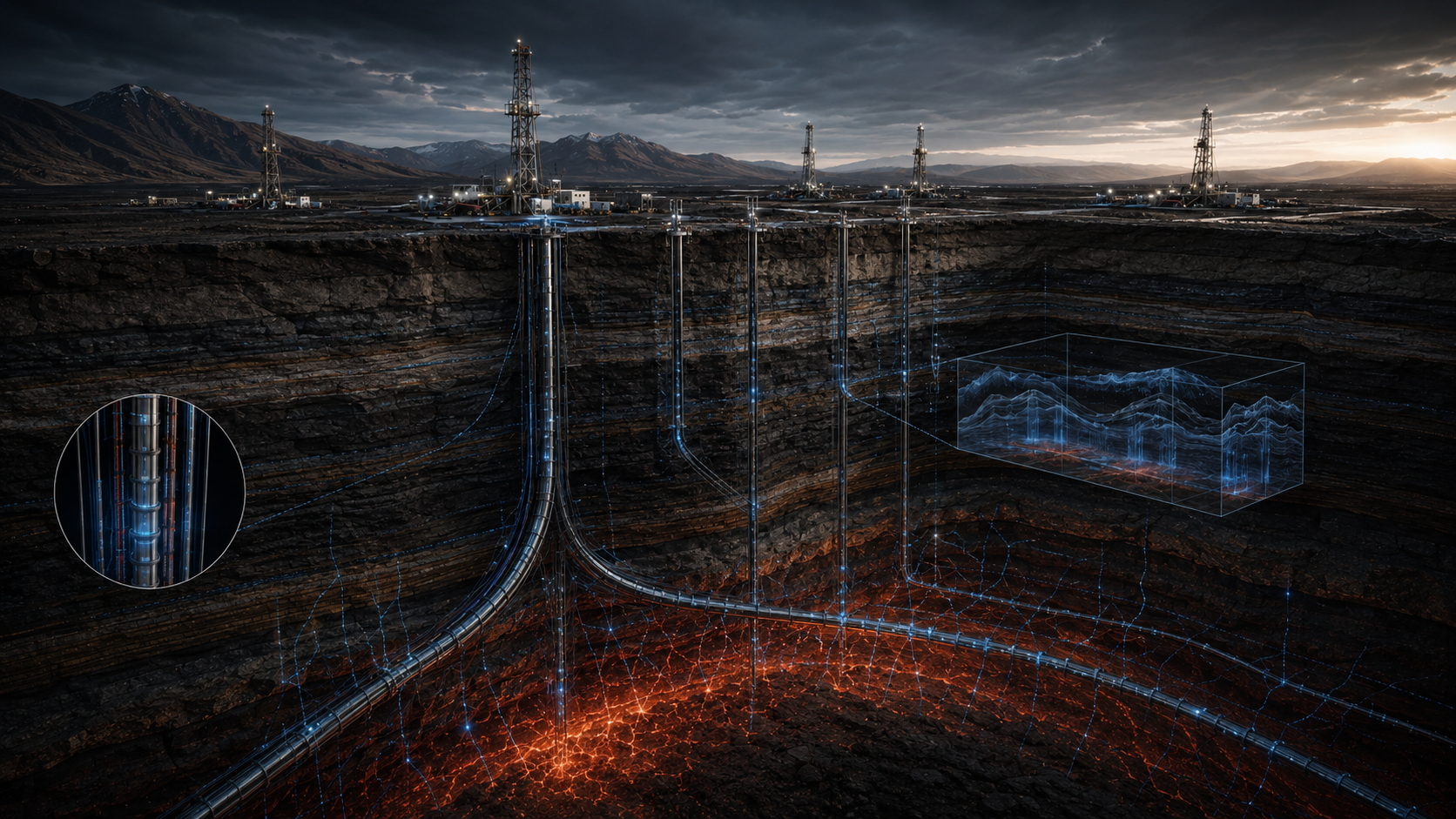
Geothermal's biggest technical challenge: finding the right reservoir underground, drilling safely and efficiently, and optimizing reservoir performance. For geothermal developers, this isn't just a cost line item—it's the critical factor determining project success. And expertise in this area comes from oil and gas.
Oilfield service companies like SLB (formerly Schlumberger), Baker Hughes, and Halliburton have spent decades drilling oil and gas wells, modeling subsurface reservoirs, and performing directional drilling. Adapting to geothermal projects is natural. In October 2025, SLB formed a strategic partnership with Ormat Technologies on EGS development, aiming to combine SLB's subsurface and drilling expertise with Ormat's geothermal and ORC experience to commercialize EGS projects.
Why does this partnership matter? Because EGS scaling is fundamentally a drilling and reservoir engineering problem. Drilling 3-10 km deep in non-volcanic areas, creating fracture networks via hydraulic stimulation, optimizing water circulation, and continuously monitoring reservoir performance require techniques the oil and gas industry has refined over 50+ years. SLB's fiber optic sensing, distributed acoustic sensors, reservoir simulation software, and directional drilling equipment are critical for EGS. Fervo Energy similarly uses fiber optic technologies to monitor reservoir performance in real-time.
An interesting asymmetry emerges: Geothermal projects require 5+ year development timelines; initial PPA revenues may begin in 3-7 years. But drilling services generate revenue in the first 1-3 years of project development. When drilling begins, companies like SLB, Baker Hughes, and Halliburton provide equipment and services; Ormat or Fervo aren't yet generating electricity. Thus first real value may flow to oilfield service companies before geothermal developers.
For SLB, geothermal remains a tiny fraction of total revenue; the core business is still oil and gas. But if geothermal grows and EGS scales, SLB's geothermal drilling services segment could show disproportionate growth. Baker Hughes pursues a similar strategy, offering geothermal drilling equipment and services, though it's not yet a primary narrative. Halliburton could play a role in EGS hydraulic stimulation but geothermal exposure remains very limited.
Drilling rig and equipment manufacturers like National Oilwell Varco (NOV), Nabors, and Helmerich & Payne also supply equipment usable for geothermal drilling, but their geothermal focus is limited; oil and gas remain the core business. Still, if geothermal grows, these companies could benefit indirectly.
The conclusion: The drilling and subsurface layer could be among geothermal's hidden winners. The SLB-Ormat partnership embodies this dynamic. For investors: If you want geothermal growth exposure, is a pure-play developer (Ormat, Fervo) or drilling service provider (SLB, Baker Hughes) the better bet? The answer depends on time horizon and risk appetite. But one thing is clear: Without EGS, geothermal can't scale; without drilling and subsurface expertise, there is no EGS.
ORC, Tubulars, Pumps: Hardware Layer
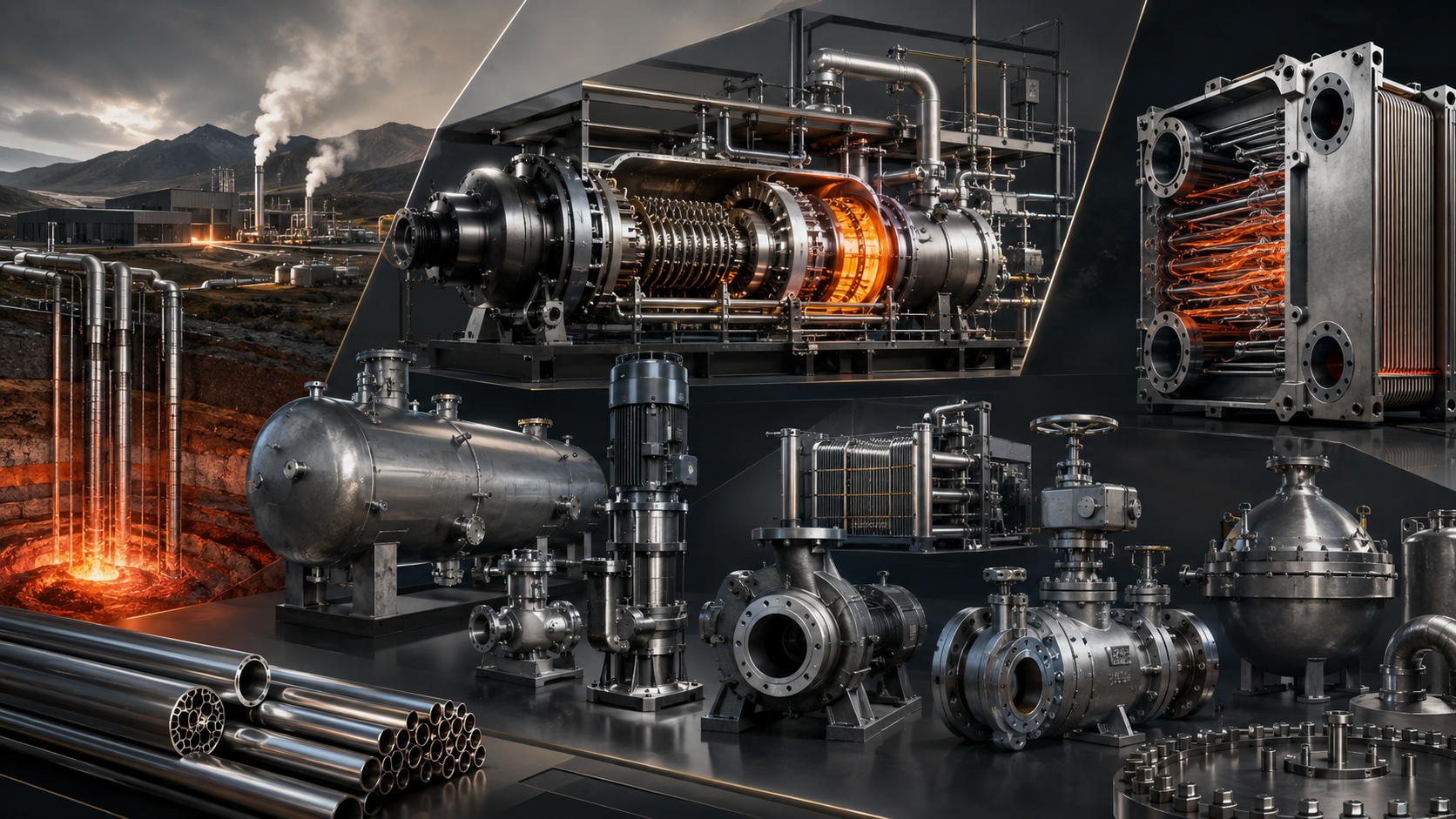
Even if drilling succeeds, systems only operate efficiently with the right equipment. Here's the supply chain's second critical layer: ORC units, premium tubulars (casing and tubulars), high-temperature pumps, and heat exchangers.
Organic Rankine Cycle (ORC) equipment forms geothermal's technical heart. Ormat Technologies leads globally with 192 patents and has been manufacturing and selling ORC units for 30+ years. Ormat doesn't just supply ORC equipment to its own plants—it also sells to other geothermal developers, diversifying revenue streams and improving margins. Companies like Turboden (Italian, not US-listed) and ElectraTherm also offer ORC solutions, but Ormat's patent portfolio and experience maintain high entry barriers.
Is there an oligopoly in the ORC equipment market? Yes. Few serious players exist because technology expertise, patent protection, and long development timelines deter new entrants. Ormat may have pricing power; as geothermal installed capacity grows, so does ORC equipment demand. However, ORC equipment is also used in areas like industrial waste heat conversion beyond geothermal, so the market isn't limited to geothermal alone.
Premium tubulars (casing and tubulars) determine geothermal well safety and longevity. Special pipes resistant to high temperature and pressure are required; standard oil and gas tubulars aren't always sufficient. Vallourec (France-based, trades on Euronext Paris) and Tenaris (NYSE: TS) are leading suppliers in this space. Both focus on oil and gas but supply premium tubulars to geothermal projects. Vallourec especially produces special steel pipes for high-temperature EGS applications.
The premium tubular market also has oligopoly structure. Limited manufacturers exist for high-temperature/pressure applications, meaning pricing power. As geothermal capacity grows, companies like Vallourec and Tenaris could benefit from tubular demand. But geothermal revenues still represent a small share of total turnover for these companies.
High-temperature pumps and heat exchangers are also critical components. Industrial pump manufacturers like Flowserve (NYSE: FLS) and Sulzer (Swiss-based) supply specialized pumps for geothermal applications. Companies like Alfa Laval (Swedish) and SPX Flow produce high-temperature heat exchangers. Most of these companies don't trade on US exchanges, or geothermal revenues represent a tiny fraction of total revenue. But if geothermal grows, these companies could benefit indirectly.
The core idea in the hardware layer: Geothermal's real bottleneck isn't just opening the well—it's operating that well safely and efficiently. ORC equipment, premium tubulars, pumps, and heat exchangers play critical roles in this process. And the supplier pool for these components is limited, meaning potential pricing power.
Monopoly / Oligopoly Power Analysis
Understanding where value accumulates in the supply chain requires examining competitive structure and entry barriers at each layer.
EGS drilling services: SLB and Baker Hughes lead here. Subsurface and reservoir engineering expertise requires 10+ years of experience; entry barriers for new players are very high. The SLB-Ormat partnership shows SLB taking strategic position in this area. Pricing power is high because alternative suppliers are few. Halliburton could enter this market but geothermal focus remains limited. Result: Oligopoly structure, high pricing power.
ORC equipment: Ormat and Turboden (not US-listed) lead. Ormat's 192 patents and 30+ years of experience create high entry barriers. New entrants like ElectraTherm create niche markets in low-temperature applications, but Ormat dominates high-temperature/large-scale ORC. Pricing power is medium-high because alternative suppliers are limited but customers negotiate long-term contracts. Result: Oligopoly structure, medium-high pricing power.
Premium tubulars: Vallourec and Tenaris lead. Limited manufacturers exist for high-temperature/pressure applications; entry barrier is high. Pricing power is medium-high; however, oil and gas tubular demand far exceeds geothermal, so the geothermal market remains marginal for these companies. Result: Oligopoly structure, medium-high pricing power but limited geothermal exposure.
Fiber optic sensing: SLB and Baker Hughes lead. Fervo Energy's use of distributed fiber optics is critical, enabling real-time EGS reservoir monitoring. Entry barrier is high because sensor technology and data analytics expertise are required. Pricing power is medium because the technology is also used in oil and gas with economies of scale. Result: Oligopoly structure, medium pricing power.
Reservoir simulation: SLB and Halliburton lead. Subsurface modeling software has very high entry barriers because it requires years of R&D and domain expertise. Pricing power is high because alternative software is scarce and customer switching costs are high. Result: Oligopoly structure, high pricing power.
High-temperature pumps: Flowserve and Sulzer lead. Not geothermal-specific; broad industrial application pool exists. Entry barrier is medium-high because special materials and engineering are required. Pricing power is medium because more alternative suppliers exist and customers show price sensitivity. Result: Oligopoly structure, medium pricing power.
The key investor question: Which layer has highest pricing power and lowest alternative supplier count? Answer: EGS drilling services (SLB, Baker Hughes) and reservoir simulation (SLB, Halliburton). ORC equipment (Ormat, Turboden) also has high entry barriers but serves a more niche market. Premium tubulars (Vallourec, Tenaris) have limited geothermal exposure.
Conclusion: If geothermal grows, disproportionate value may flow to drilling service companies like SLB and ORC equipment manufacturers like Ormat. These companies hold oligopoly positions with pricing power.
How Money Flows from AI to Geothermal
How does the process work from AI data center operators signing geothermal PPAs to geothermal-supplying companies making money? Understanding time horizon and value flow is critical for building an investment thesis.
0-12 months: PPA announcements and narrative pricing
The Google-Ormat 150 MW deal and Fervo Energy's IPO exemplify this period. When hyperscalers sign geothermal PPAs, news hits the market and geothermal company stocks move. Ormat's 8.1% rise post-Google deal shows this dynamic. Fervo's IPO similarly leveraged the Google partnership as its primary narrative, raising $1.89 billion. During this period, investors buy "theme"; real cash flow doesn't yet exist but expectations are strong.
1-3 years: Drilling begins and equipment orders placed
After PPA signing, project development starts with drilling. Drilling service companies like SLB and Baker Hughes enter. They provide directional drilling, reservoir modeling, hydraulic stimulation services and invoice for them. Simultaneously, ORC equipment, tubulars, and pumps are ordered. Companies like Ormat, Vallourec, and Flowserve begin generating revenue. But the geothermal developer (Ormat or Fervo) isn't yet producing electricity—meaning no PPA revenue. First winners in this phase are drilling and equipment suppliers.
3-7 years: Initial production and PPA revenues begin
After drilling completion and system installation, the geothermal plant begins production. PPA revenues start flowing. Hyperscalers like Google and Microsoft begin purchasing electricity, and geothermal developers (Ormat, Fervo) generate cash flow. But reaching this point can take 5+ years, requiring long-term investment patience. Drilling service and equipment suppliers already began generating revenue in years 1-3.
7+ years: EGS's potential transformation into mainstream energy
If EGS technology succeeds at scale and breaks the cost curve, geothermal could become a globally accessible energy source. In that scenario, EGS leaders like Fervo could create massive value. The SLB-Ormat partnership would also benefit from EGS commercialization. But this scenario isn't yet proven; EGS technology could fail at scale, drilling costs could exceed expectations, geological uncertainties could delay projects. Thus the 7+ year horizon is speculative.
Conclusion: First geothermal growth winners are drilling services and equipment suppliers. Geothermal developers start generating cash flow 3-7 years out. For investors: Do you prefer short-term revenue (SLB, Baker Hughes, Ormat ORC equipment) or long-term cash flow (Ormat producer, Fervo)? The answer depends on risk appetite.
Geothermal vs Nuclear / Gas / Solar / Wind
Understanding geothermal's strategic position requires comparison with other energy sources.
Nuclear: Highest capacity factor (91%) and strongest baseload power source operating 24/7. But very high CAPEX, 10+ year permitting, and social acceptance issues exist. Amazon's $650 million nuclear deal with Talen Energy shows hyperscaler interest in nuclear. Geothermal can deploy faster than nuclear (5 years vs 10+ years) but has lower capacity factor (66-91% vs 91%). For AI data centers, nuclear is ideal but permitting and social acceptance challenges make geothermal advantageous.
Natural gas: Strongest alternative in low CAPEX, fast deployment, and flexibility. But it produces carbon emissions, opposing hyperscalers' carbon-zero targets. Natural gas price volatility also creates risk. Geothermal is slower and more expensive than natural gas but aligns with clean energy goals. Hyperscalers' carbon targets will be decisive; if carbon emissions are unacceptable, natural gas falls back and geothermal advances.
Solar and wind: Advantageous in low CAPEX, fast installation, and mature technology. But intermittent generation and battery storage needs mean they can't alone meet 24/7 data center needs. Adding battery storage costs, solar+battery or wind+battery combinations can approach geothermal's total cost. Geothermal far exceeds solar and wind in providing baseload, though solar and wind are cheaper and faster to install.
Battery storage: Can balance solar and wind intermittency but is expensive with limited discharge duration. Geothermal generates 24/7 electricity without battery storage, reducing total ownership cost. Battery storage combined with geothermal/nuclear could create a more flexible energy system but alone doesn't provide baseload.
Conclusion: Geothermal isn't a niche solution in AI data center energy strategy—it's a real baseload alternative. Nuclear is stronger but slower; natural gas is faster and cheaper but carbon-intensive; solar and wind are cheaper but weak on baseload. Geothermal offers a balanced alternative among these options: clean, continuous, deployable in 5 years, and less affected by nuclear's social acceptance issues. But high CAPEX and geological risk mean not every project will succeed.
Time Horizon: Who Wins When?
0-12 months: PPA announcements, IPOs, and narrative pricing dominate. Fervo's May 13, 2026 IPO raising $1.89 billion and Ormat's 8.1% post-Google deal rise exemplify this. Investors buy "theme"; real cash flow doesn't yet exist but expectations are strong. Geothermal developers (Ormat, Fervo) and drilling service companies (SLB, Baker Hughes) can benefit from stock narrative. But this period brings high volatility; news prices quickly and stock movements are sharp.
1-3 years: Drilling begins, equipment orders placed, service revenues start. Drilling service companies like SLB and Baker Hughes, ORC equipment makers like Ormat, tubular suppliers like Vallourec, and pump makers like Flowserve begin generating revenue. Geothermal developers aren't yet producing electricity—no PPA revenue. First winners this phase are supply chain players. The SLB-Ormat EGS pilot falls in this timeframe; when drilling starts, SLB generates service revenue.
3-7 years: Initial production, PPA revenues begin, and scaling occurs. When geothermal plants start production, hyperscalers like Google and Microsoft begin purchasing electricity and geothermal developers (Ormat, Fervo) generate cash flow. But reaching this point can take 5+ years—patience required. Utilities like Constellation Energy with Calpine geothermal assets could also benefit from PPA revenues in this period.
7+ years: EGS's potential transformation into mainstream energy and global scaling. If EGS technology succeeds at scale, EGS leaders like Fervo could create massive value. The SLB-Ormat partnership could also disproportionately benefit from EGS commercialization. But this scenario isn't yet proven; EGS technology could fail at scale. Thus the 7+ year horizon is speculative and high-risk.
Conclusion: Short-term winners are supply chain players (SLB, Ormat ORC equipment, Vallourec); medium-term winners are geothermal producers (Ormat, Fervo); long-term winners are EGS leaders (Fervo, SLB-Ormat partnership). Investors should position according to time horizon.
Critical Risks
The geothermal theme may be strong, but ignoring risks is a mistake. Here are critical risks investors must consider:
EGS technology may not scale: Though Fervo's Nevada pilot succeeded, whether this technology can break the cost curve at large scale remains uncertain. Hydraulic stimulation costs could exceed expectations, drilling failures could increase, and reservoir performance could decline long-term. If EGS fails, companies like Fervo could struggle and investors could face losses.
Geological risk is bigger than investors think: Reservoir quality and drilling success can't be fully known in advance. Until a well is drilled, true reservoir temperature, permeability, and water capacity remain uncertain. Failed wells aren't just time losses—they're direct costs ranging $10-30 million. Unlike classical geothermal, EGS attempts to create artificial reservoirs rather than tap natural ones, amplifying geological risk.
High CAPEX limits competitiveness: Per-MW geothermal investment cost is roughly 3x that of solar and wind. This makes project financing harder and extends payback periods. Despite carbon targets, hyperscalers remain cost-sensitive; if geothermal becomes too expensive versus natural gas or nuclear, it may not be preferred.
Long development timelines could lose the competition: Geothermal project licensing, drilling, and construction takes 5+ years. During that time, natural gas plants can deploy in 1-2 years, solar and wind in 1-3 years. AI data center energy needs are urgent now; rather than wait 5 years, they may turn to faster solutions.
Natural gas and nuclear could be cheaper/faster: Natural gas offers low CAPEX and fast deployment; nuclear has the highest capacity factor (91%). Hyperscalers' carbon-zero targets are strong, but energy security and cost matter too. If carbon capture and storage (CCS) makes natural gas "clean" or small modular nuclear reactors (SMRs) rapidly proliferate, geothermal's competitive advantage could weaken.
Narrative pricing may already have started in geothermal stocks: Fervo's May 13, 2026 IPO raised $1.89 billion—a high valuation for a not-yet-profitable company. Ormat's 8.1% rise post-Google PPA shows the market actively pricing the geothermal theme. Investors may be overpaying for geothermal stocks due to the "AI energy story." If projects progress slower than expected or costs exceed forecasts, these premiums could erode quickly.
Pure-play geothermal exposure on US exchanges is very limited: Beyond Ormat and Fervo, no pure-play geothermal companies trade on US exchanges. Other exposures are indirect: oilfield service firms like SLB, Baker Hughes, Halliburton; utilities like Constellation; conglomerates like Berkshire Hathaway. These companies' geothermal revenues represent tiny shares of total turnover. Thus "investing in the geothermal theme" often actually means "getting exposed to geothermal's side effects."
Incentive, permitting, and regulatory uncertainty: Turkey's example of YEKDEM deadline pressure suspending geothermal investments shows regulatory uncertainty's impact on projects. Similar risks exist in the US: federal and state incentives could change, environmental permits could delay, local communities could oppose geothermal (especially due to earthquake risks hydraulic stimulation might trigger). These uncertainties can further extend project development timelines.
Final Synthesis: Where Does Value Accumulate?
Can geothermal energy become a strategic 24/7 clean power solution in the AI age? Answer: Yes, it can. But it's not certain. Geothermal competes with nuclear, natural gas, solar, and wind—each has advantages. Geothermal's unique strength is uninterrupted clean baseload; its weakness is high CAPEX, geological risk, and long development timelines.
So what is the market pricing correctly today, and what's it missing? The market has begun pricing the geothermal theme: Fervo's $1.89 billion IPO, Ormat's 8.1% post-Google PPA rise demonstrate this. But the market hasn't fully priced the supply chain yet. Drilling service companies like SLB and Baker Hughes remain secondary in the geothermal narrative; yet these firms could be first winners if EGS scales. Similarly, Ormat's ORC equipment segment gets less attention than its producer segment—yet ORC equipment is high-margin and oligopolistic.
Where is the most asymmetric opportunity for investors—in producers, drilling, or equipment? The answer depends on your portfolio strategy:
- If you seek short-term revenue: SLB, Baker Hughes (drilling services), Ormat (ORC equipment sales). These companies generate revenue from geothermal projects within 1-3 years.
- If you seek medium-term cash flow: Ormat (producer segment), Constellation Energy (Calpine geothermal assets). These companies benefit from PPA revenues in 3-7 years.
- If you want to bet on long-term EGS optionality: Fervo, SLB-Ormat partnership. These positions carry high risk, high potential; require 7+ year horizon.
Where is geothermal's real bottleneck in the AI age? Drilling and reservoir engineering. EGS scaling is fundamentally a subsurface problem. Thus first real value may flow to oilfield service companies like SLB and Baker Hughes before geothermal developers. The second bottleneck is ORC equipment; limited suppliers like Ormat and Turboden exist with high entry barriers.
Final word: Geothermal can be strategic. But not every geothermal stock is a good investment. EGS companies like Fervo carry narrative intensity but very high technology risk. Ormat is more mature but project development timelines are long. Drilling service companies like SLB occupy "hidden winner" positions; geothermal isn't their primary narrative but indirect exposure is real. Investors should see the difference between theme and stock, clearly define time horizons, and pay attention to narrow players in the supply chain. Because if geothermal grows, first real gains may often accumulate in the invisible supply chain layers.


