
The Same Budget Does Not Mean the Same Thing for Everyone
On April 2, 2026, the White House released the FY2027 defense budget framework. The headline number: $1.5 trillion. That figure is large enough and symbolic enough to generate an immediate reflex in markets — defense spending is going up, therefore buy defense stocks. But that reading, while directionally correct, is dangerously incomplete.
Inside the same $1.5 trillion budget request sit four radically different stories. First, munitions: with stockpiles eroding at alarming speed during the Iran war, this is the most immediate and conversion-fast segment in the cycle — acuity is operationally documented, not rhetorical. Second, shipbuilding: a multi-decade naval modernization effort with an impressive backlog but slow execution. Third, Golden Dome and missile defense: enormous headline potential but architecture still classified, with real spending spread over years. Fourth, defense software and AI: having crossed the threshold from pilot projects to program of record status, this is the layer beginning to generate multi-year recurring revenue but also carries the most stretched valuations in the space.
The right question for investors is not "did defense spending go up?" but rather: through which mechanism, in what time horizon, and for which specific company? Answering that question requires abandoning the idea that everything under the same banner trades the same way.
Why This Budget Proposal Actually Looks Different
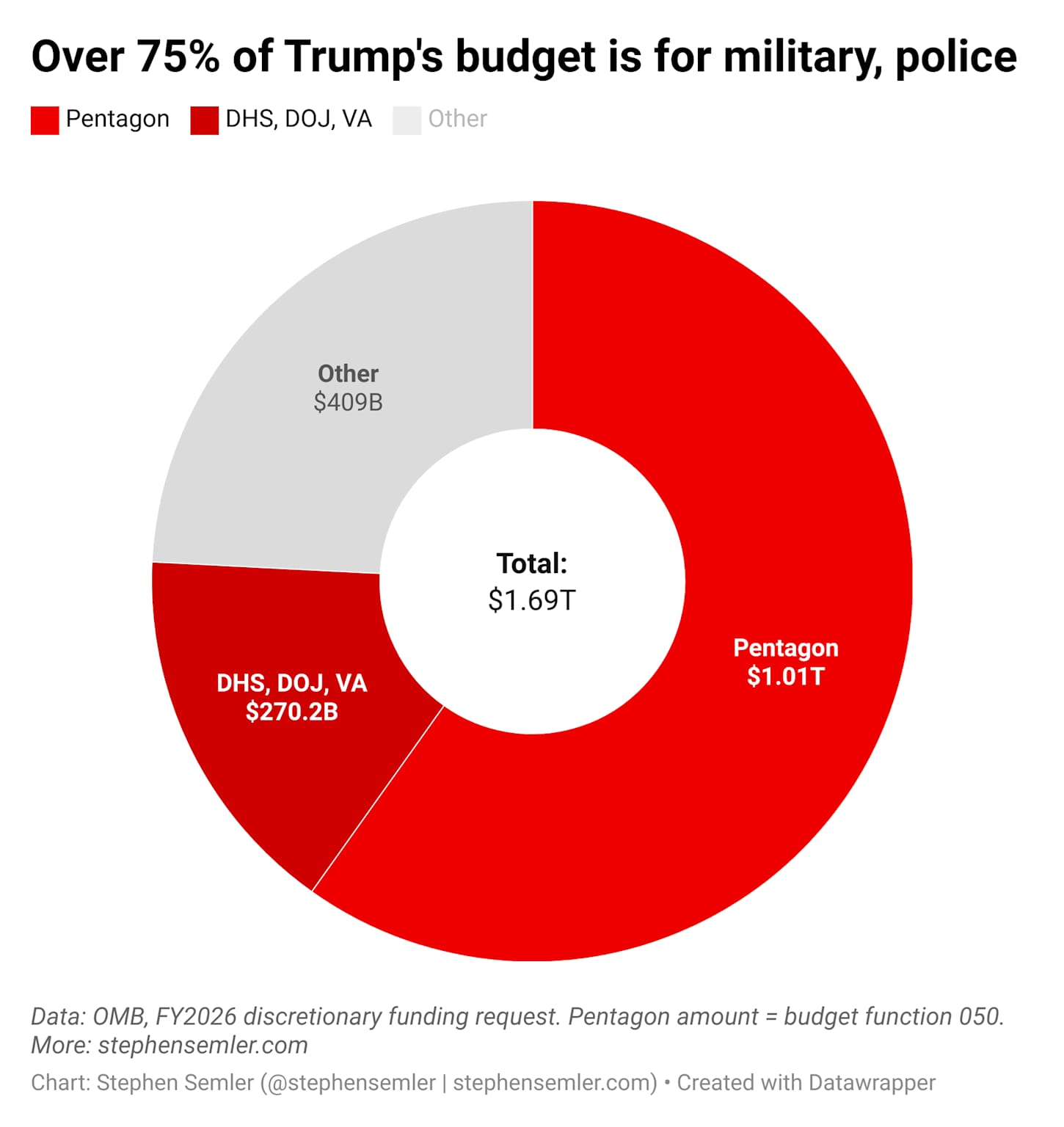
The FY2027 request is mathematically historical. The structure is: $1.15 trillion in direct DoD appropriations the first time the base defense budget exceeds $1 trillion plus $350 billion requested through the budget reconciliation process, directed at critical munitions, defense industrial base expansion, and related priorities. Combined: a ~44% increase from FY2026 levels.
Historical context matters here. During the Reagan defense peak, US military spending reached approximately 6% of GDP. The FY2027 request translates to roughly 4.5–5% of current GDP. The administration's framing of "exceeding the Reagan buildup" is partly rhetorical, but the 1 trillion dollar base threshold carries genuine institutional significance: it effectively normalizes "minimum $1 trillion" as the new floor for annual defense spending. Reading FY2026 (with its $903 billion NDAA base plus $150 billion in reconciliation defense funding through the "One Big Beautiful Bill") alongside FY2027 suggests two consecutive years of deliberate, above-trend expansion which is structurally more credible than a single spike.
However, a critical distinction must be made upfront: a budget proposal and enacted spending are different things. The $350 billion reconciliation package requires Congress to complete its own budget process successfully. With a narrow GOP majority where a handful of votes can derail legislation, this package carries real legislative risk. The single greatest risk in this cycle is an investor conflating the headline request with guaranteed appropriated dollars.
What makes this budget proposal operationally grounded rather than purely aspirational is the Iran war context. In the first 16 days of operations, the US consumed more than 6,000 munitions, including an estimated 46% depletion of ATACMS stocks and approximately 40% of US-operated THAAD interceptors. Tomahawk usage in a single month exceeded all prior historical campaigns combined. This is not a projection or a doctrine exercise these are live consumption data points that prove the munitions and defense industrial base case with empirical clarity.
The Major Market Narratives Which Ones Are Actually Supported?
Several large narratives have formed around this defense expansion. They deserve to be assessed with different levels of confidence.
A multi-year structural defense spending cycle: Strongly supported but conditional. The sequential growth from FY2026 to FY2027, combined with allied rearmament globally, makes this more than a reactive panic cycle. What could break this thesis: reconciliation failure or an abrupt end to the Iran conflict removing political urgency.
Munitions and defense industrial base expansion as the most immediate beneficiary: Strongly supported, with real-world data driving it. CEO commitments at the White House munitions meeting to quadruple production, Lockheed's framework agreement to multiply PrSM output, RTX's doubled AMRAAM production these are not declarations of intent but signed contracts. The risk is production lead times: even with contracts in hand, delivery delays of two to four years are typical.
Golden Dome as a new budget engine: Partially supported with high uncertainty. The SHIELD IDIQ framework is real a $151 billion, 10-year ceiling with more than 2,100 approved firms — but the architecture remains classified. Of the $17.5 billion requested for Golden Dome in FY27, only $400 million comes from the base budget; the rest depends on reconciliation. The program could be a major multi-year budget driver, but cash flow reaching corporate income statements is a years-long process.
Shipbuilding as a long-duration backlog story: Strongly supported over the long term, weak on near-term execution. 34 ships and $65.8 billion is a powerful signal; the Navy Secretary's projection that FY27 could double FY26 ship procurement adds credibility. But a destroyer or nuclear submarine runs three to seven years from contract award to delivery. This is a real story just not a 12-month story.
Defense AI as a new margin layer: Partially to strongly supported, valuations stretched. Maven Smart System's program of record designation is a genuine structural milestone. But Palantir trades at approximately 131x forward P/E. Much of the good news appears to already be priced.
Prime contractor stocks offering good value: Weakly supported. Sector P/E at 44.8x versus a three-year historical average of 32.1x suggests the sector has priced in considerable growth already.
Sub-Segment Analysis The Same Budget Does Not Pay Everyone Equally
Munitions / Ammunition: The Fastest Conversion Mechanism
The most direct and near-term earnings conversion within this budget cycle runs through the munitions segment. This is driven equally by contracted urgency and documented inventory depletion. With PAC-3 interceptors being consumed at rates that exceed Lockheed's standard production capacity of 600 units per year, and with Tomahawk inventories running historically thin, production expansion became operationally necessary rather than strategically aspirational. The DoD and Lockheed have signed a framework agreement to multiply PrSM production fourfold. At the White House meeting, RTX, Lockheed, Northrop Grumman, L3Harris Missile Solutions and others committed to quadrupling output of "exquisite class" munitions.
Approximately 402 PAC-3 interceptors were estimated used in the conflict's first 16 days against a production capacity of 600 per year. Even with expanded production agreements, typical delivery timelines run two to three years from contract signature to delivery.
RTX Corporation (RTX) is the clearest multi-vector beneficiary. A $268 billion backlog, doubled AMRAAM production, PAC-3 supplier role, and SHIELD Golden Dome IDIQ awardee status give this company short-to-medium-term visibility across both the munitions and missile defense segments. Risk: approximately $600 million in tariff cost exposure and sector-high valuation at P/E 37.87x.
Lockheed Martin (LMT) carries $179 billion in backlog, FY27 guidance of 85 F-35 deliveries (double FY26), accelerated PAC-3 production and the PrSM expansion framework. At a forward P/E of approximately 21.9x, it sits at the more defensible end of defense sector valuations. Revenue guidance for 2026: $77.5–80 billion.
L3Harris Technologies (LHX) is increasingly positioned within the munitions cycle through its Missile Solutions segment targeting $4.4 billion in revenue, a record $27.5 billion backlog and direct representation at the White House production meeting. Morgan Stanley assigned Overweight.
The structural risk in this segment: even with the best intentions, critical mineral dependencies gallium, germanium, and others dominated by Chinese suppliers impose practical ceilings on how fast production can scale. The "quadruple production" commitment is directionally correct; the timeline is not 12 months.
Missile Defense / Golden Dome: High Potential, Heavy Architecture
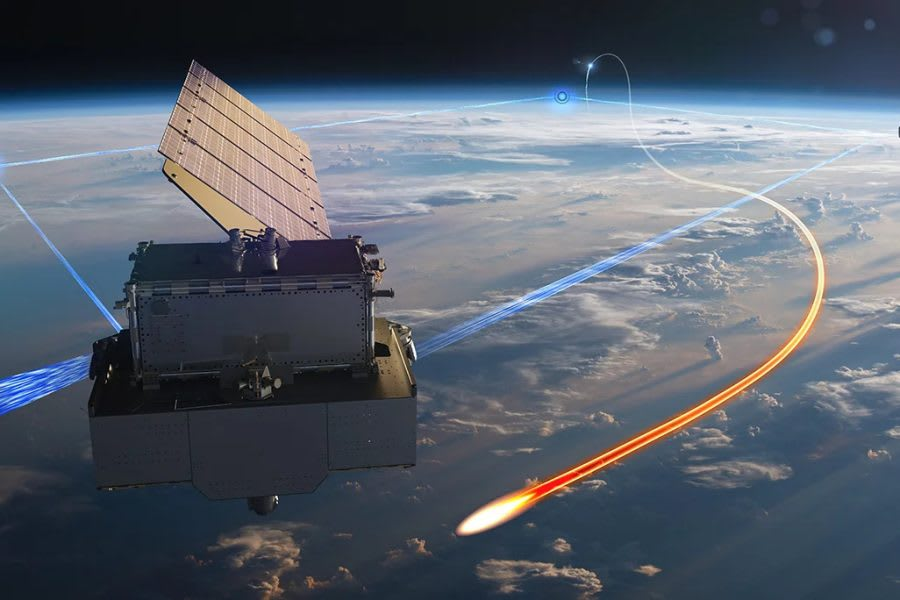
Golden Dome is the most prominently announced program in this budget cycle. Conceptually, it targets a layered missile shield combining space-based sensors, kinetic and non-kinetic interceptors, and battle management software. The Pentagon's SHIELD IDIQ framework is already in place: a $151 billion ceiling over 10 years with more than 2,100 firms pre-approved to compete. Space Force has begun issuing space sensor contracts.
The FY27 request assigns $17.5 billion to Golden Dome but again, only $400 million of that sits in the base budget, with the remainder reconciliation-dependent. This makes Golden Dome's near-term funding profile highly contingent. If reconciliation passes in full, this becomes a major engine. If Congress trims it, FY27 actual Golden Dome spending could land close to $400 million.
Key names: Northrop Grumman (NOC) in space-based sensors and battle management, alongside B-21 production acceleration; RTX in interceptors and radar; L3Harris in electronic warfare and sensors; Anduril, in consortium with Palantir, for the software management layer. True Anomaly and other small space-defense startups received early Space Force awards. Large contracts in this segment are expected in 2027–2028 at the earliest making this a medium-to-long-duration story.
Shipbuilding / Naval: Impressive Backlog, Heavy Execution Risk
Thirty-four ships. $65.8 billion. "Trump-class battleship" initial funding. Next-generation frigates. When the Navy Secretary projects that FY27 could double FY26 ship acquisition, the ambition is real. But shipbuilding is not a grocery store.
Building a nuclear-powered submarine particularly a Virginia or Columbia class requires tens of thousands of highly specialized operations, performed by workers with skills built over years. HII experienced severe workforce challenges across both Newport News and Ingalls Shipbuilding throughout 2025, with first-year employee attrition reportedly at 50–60%. The company responded by pivoting away from "green" hiring toward experienced shipbuilders. Throughput improved 14% in 2025; the 2026 target adds another 15%. That momentum is real. But converting a $57 billion backlog at a pace of ~$9.7–9.9 billion in annual revenue takes years.

Huntington Ingalls Industries (HII) is the dominant and effectively sole provider of large nuclear naval vessels for the US Navy. CVN-80, Virginia and Columbia class submarines, Arleigh Burke destroyers. Record 2025 revenue of $12.5 billion. 2026 guidance: 5.5–6.5% shipbuilding operating margin. Fixed-price contract exposure to cost inflation is the key margin risk. S&P revised HII's outlook to Stable from Negative; free cash flow guidance of approximately $600 million is real but not spectacular relative to the backlog size. The company's investment in robotic welding integration — what it calls "Physical AI" — is a credible productivity story worth tracking.
General Dynamics (GD) secured a $15.4 billion Navy contract for the Columbia-class submarine program and Electric Boat announced plans to hire 2,250 workers. However, UAW members at Electric Boat previously authorized a strike, keeping labor risk alive. GD's Gulfstream business jet segment adds revenue diversification but also dilutes the pure defense thesis.
Shipbuilding is the segment with the strongest backlog accumulation from this budget cycle but the slowest and most friction-laden backlog-to-revenue conversion. It is a long-horizon investment not a backlog-to-earnings story for the near term.
Aerospace / Air Defense: Near-Term Visibility From Existing Contracts
F-35 deliveries are projected at 85 units in FY27 double FY26. This benefits Lockheed directly through production scaling and per-unit economics. The F-35 program has historically battled delivery delays, software delays, and rising unit costs, which means faster ramp-up carries execution risk alongside the obvious revenue opportunity.
Northrop Grumman (NOC) approached a deal with the Air Force to accelerate B-21 Raider production by approximately 25%. Northrop absorbed roughly $2 billion in upfront costs during the B-21 production ramp; those costs are now converting into margin contribution. Combined with Space Force positioning and SHIELD awardee status, NOC is arguably the widest-exposure name across this entire budget cycle.
Drone / Autonomy / Unmanned Systems: Among the Fastest-Growing Budget Lines
For the first time in FY2026, a dedicated AI and autonomy budget line appeared: $13.4 billion, with $9.4 billion toward aerial unmanned systems, $1.7 billion toward maritime autonomy, and $1.2 billion toward software integration. This trend is expected to accelerate in FY27. The Iran conflict further validated the asymmetric value of drone warfare cost-effective attritable platforms proved their battlefield utility.
Anduril Industries is the largest player in this space, still private. The Army's 10-year, $20 billion (ceiling) AI integration contract and the Marine Corps' $642 million counter-drone award establish Anduril's operational scale. Its reported Golden Dome software partnership with Palantir adds a further dimension. An eventual Anduril IPO would be a significant pricing event for this entire sub-segment.
Kratos Defense & Security Solutions (KTOS) offers the strongest publicly-traded product-doctrine fit in this space. Valkyrie (XQ-58A) and Gremlins directly embody the "affordable mass" doctrine high-volume, low-cost, attritable drone platforms. Backlog at a record $1.57 billion; 2026 revenue growth guidance of 13–19%. Risks: small market cap, customer concentration, and production scaling challenges.
AeroVironment (AVAV) leads the small UAS market with Switchblade, JUMP 20 and Puma systems. The $9.4 billion aerial autonomy budget line provides a credible long-term demand driver. However, the company cut its FY2026 guidance citing government contract delays a near-term caution signal.
Where Is AI Actually Making Real Money in Defense?
The defense AI narrative tends to polarize: either uncritical enthusiasm ("AI will transform everything") or reflexive skepticism ("real spending isn't there yet"). The honest answer sits closer to the former, with one major caveat on valuation.
On March 9, 2026, Deputy Secretary of Defense Steve Feinberg signed a memo formally designating Palantir's Maven Smart System (MSS) as a program of record. What does that designation mean in practice? When Project Maven launched in 2017, it was an experimental project using computer vision to analyze drone surveillance footage. By March 2026, it is a fully deployed system targeting full military-wide integration with a delivery timeline to FY-end September 2026. The program-of-record status converts Maven from a cancelable pilot contract into a budgeted workstream multi-year financial visibility, institutionally embedded, not easily terminated.
Maven was in active operational use during the Iran conflict, reportedly classifying more than 1,000 targets within hours. It is no longer a demonstration technology.

Palantir Technologies (PLTR) is the clearest beneficiary. US government revenue in Q4 2025 reached $570 million, up 66% year-over-year. FY2026 revenue guidance of approximately $7.2 billion implies ~61% growth. Gross margin of approximately 82% and operating margin of approximately 31.6% substantially exceed those of traditional prime contractors (typically 8–12% operating margin). The structural advantage is software-native unit economics: near-zero marginal cost per additional platform deployment, significant switching costs once embedded in operational workflows, and no capital-intensive production facilities to maintain. The problem: ~131x forward P/E has priced in essentially all of this — and more. From here, Palantir needs to keep surprising. Any material setback a large competitive entry, program scope reduction, or budget sequester could trigger meaningful valuation compression.
Leidos Holdings (LDOS) offers a quieter but more defensively valued exposure to the same themes. The Defense Enclave program, Air Force Cloud One ($454.9 million contract), DISA AI governance awards, and a diversified federal IT portfolio position Leidos as the "infrastructure layer" beneath the AI stack. Moderate valuation relative to Palantir, long-term contract visibility, and SHIELD awardee status make this a less exciting but more balanced entry point.
Booz Allen Hamilton (BAH) maintains a deeply embedded position in government AI advisory work, cyber, and ISR analytics. SHIELD awardee. Consulting margins are lower than hardware or software margins, but the recurring engagement model generates predictable revenue.
Within defense AI, the sub-segments operate on meaningfully different timelines. Battlefield C2 and targeting (Palantir's strongest domain) is already in deployment. ISR analytics (Palantir + Leidos + Booz Allen) is maturing. Drone AI and autonomy stack (Anduril + Kratos) is in early production scaling. Cyber threat detection (Leidos + L3Harris) is a steady-state spend growing with Zero Trust mandates. Predictive maintenance and logistics AI (SAIC + Leidos) is underfunded relative to potential. Manufacturing automation AI inside prime contractors' own factories is an internal investment story.
The central question is defense AI creating a genuine new margin layer? is largely yes for first movers, with a durability caveat. Palantir's 82% gross margin versus a legacy contractor's 10–12% operating margin represents a structural difference, not a temporary anomaly. Software-native platforms generate recurring, scalable revenue without proportional cost growth. The risk to this premium is competitive: if Microsoft, Google, or Anduril achieves comparable platform embeddedness at DoD, Palantir's pricing power weakens. For now, the Maven PoR creates a multi-year ecosystem moat. But moats at 131x forward P/E require constant reinforcement.
Cybersecurity / ISR / Space Defense / Supply Chain
Less dramatic but structurally important. DoD's IT budget reached $66 billion, pivoting toward AI and efficiency. Zero Trust mandates drive cybersecurity modernization contracts. Leidos, SAIC, and Booz Allen are the steady-income generators here.
Space Force's FY2026 budget grew 30% year-on-year to $40 billion, with Golden Dome's space-based sensor requirements adding further acceleration. Northrop Grumman, L3Harris, and emerging names like True Anomaly are the primary beneficiaries. The architecture remains partially classified; contract timing is uncertain.
In the supply chain tier, TransDigm Group (TDG) leverages its dominant position in proprietary aerospace components to capture pricing power as prime contractors scale production. Not a direct government contractor — rather a Tier 2/3 supplier that benefits indirectly from production ramp-ups. High leverage on the balance sheet is the primary risk.
The Stock Impact Map Who Wins Directly, Who's Delayed, Who Is Already Overpriced?
RTX Corporation (RTX) At the Munitions-Missile Defense Intersection
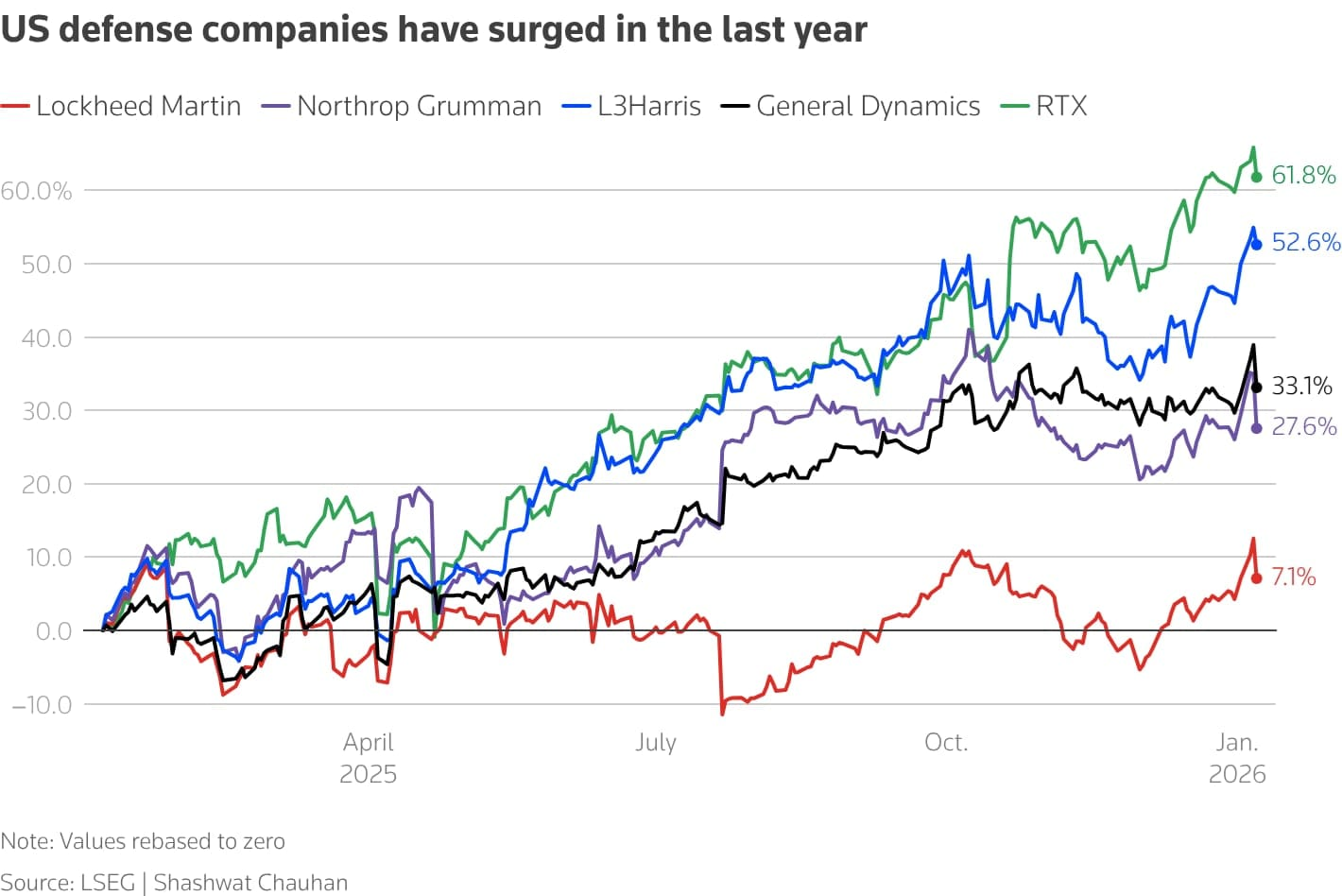
RTX is this budget cycle's most multi-dimensional impacted name. Positioned in both munitions (PAC-3, AMRAAM, Stinger) and Golden Dome/SHIELD (radar, interceptors). A $268 billion backlog provides near-term revenue visibility. The AMRAAM doubling is contractually grounded. Diversification through Pratt & Whitney engines adds non-defense revenue exposure versus Lockheed. Headline winner but valued accordingly: P/E of 37.87x is above-average for the sector. Tariff exposure of approximately $600 million is a near-term margin headwind.
Lockheed Martin (LMT) — F-35, PAC-3, and the Backlog Visibility Play
When the defense budget grows, Lockheed's name appears at the top of every list — and the mechanism justifies it. $179 billion in record backlog, 85 F-35s in FY27, accelerating PAC-3 production, and the PrSM multiplication framework. 2026 revenue guidance: $77.5–80 billion. Real earnings conversion story: This company's strength is that its backlog ties directly to delivery schedules not theoretical, but contractually scheduled revenue. Forward P/E of approximately 21.9x is the more defensible entry within large-cap defense. Risk: F-35 program execution constraints and delivery timing variability.
Northrop Grumman (NOC) — B-21, Space, and the Missile Defense Trifecta
NOC offers the widest thematic exposure in this cycle: B-21 production acceleration of 25%, SHIELD IDIQ awardee status, Space Force contracts. The previously absorbed ~$2 billion in B-21 upfront costs is now reversing into margin contribution. Delayed but high quality: This name carries a 2–4 year thesis. Risk: space and missile defense architecture uncertainty makes contract size projection difficult until the Golden Dome blueprint is published.
L3Harris Technologies (LHX) — Quiet Strength in Missile Solutions and Electronic Warfare
LHX is the quietly positioned name in this cycle. Its CEO attended the White House munitions meeting. Missile Solutions targeting $4.4 billion in revenue. Record $27.5 billion backlog. Electronic warfare and ISR exposure provides Space Force upside. Morgan Stanley: Overweight. Less noise, solid mechanism. Forward valuation is at the more moderate end of the sector.
Huntington Ingalls Industries (HII) — The Only Large Naval Shipbuilder
HII has no meaningful domestic competitor for nuclear capital ships. That monopoly position is both its greatest asset and its ceiling. A $57 billion backlog, Virginia and Columbia class submarines, CVN-80 Ford-class carrier, the Kennedy reaching sea trials in 2026. Operating margin at 5.6% shipbuilding segment. A 18% labor cost increase creates margin compression that won't fully resolve in 2026. Long-duration backlog play: A 5–7 year position, not a 12-month trade. S&P stabilized the outlook; free cash flow guidance of ~$600 million is real. The "Physical AI" robotic welding initiative could be a slow-burn margin catalyst.
General Dynamics (GD) — Electric Boat and the Columbia Submarine Commitment
A $15.4 billion Columbia-class contract and 2,250 new Electric Boat hires signal serious commitment. Prior UAW strike authorization keeps labor risk alive. Gulfstream diversification softens the pure defense thesis. Delayed winner: Long backlog visibility, but near-term earnings contribution is limited. Execution quality not demand is the binding constraint.
Palantir Technologies (PLTR) — Maven PoR and the AI Premium
Maven Smart System program of record. Operational in the Iran conflict (1,000+ targets classified within hours). Army enterprise AI agreement (~10-year, $10 billion ceiling). FY2026 revenue guidance ~$7.2 billion, +61% growth. 82% gross margin. The fundamental case is real. At ~131x forward P/E, however, the stock is essentially pricing in continuous positive surprises. AI/defense software beneficiary valuation trap risk if growth disappoints. Any material negative competitive entry, program scope reduction, budget sequester triggers compression from a high base.
Leidos Holdings (LDOS) — Defense AI's More Balanced Alternative
Half the valuation noise of Palantir, operating in overlapping terrain. Defense Enclave, Cloud One, DISA AI contracts, Zero Trust infrastructure. Growth rate lower than Palantir; valuation considerably more moderate. SHIELD awardee adds a potential catalyst. Delayed but quality: The IT modernization cycle's quiet beneficiary. Worth monitoring for improved revenue guidance in 2026.
Kratos Defense & Security Solutions (KTOS) — The Affordable Mass Proxy
The "affordable mass" doctrine — high-volume, low-cost, attritable drone platforms for multi-domain attack maps directly onto Valkyrie and XQ-58A. Record $1.57 billion backlog, 13–19% revenue growth guidance. Speculative but mechanistically grounded: Small-cap volatility and customer concentration risk are real. If Anduril's eventual IPO creates a valuation reference point for defense autonomy platforms, Kratos could see significant re-rating.
AeroVironment (AVAV) — Small UAS Market Leadership
Switchblade, JUMP 20, Puma position AVAV well in the small UAS category directly addressed by the $9.4 billion aerial autonomy budget line. Guidance cut citing contract delays is a near-term warning. Watch and assess: The long-term demand story is credible. Execution timing on government contracts is the variable that needs clarity.
Booz Allen Hamilton (BAH) and TransDigm (TDG)
Booz Allen: SHIELD awardee, established government AI and cyber advisory presence, predictable recurring revenue model, lower margins than hardware or software peers. A stable compounder rather than a high-beta defense play. TransDigm: proprietary aerospace component pricing power extracts indirect value from production ramp-ups across the munitions and aircraft cycle; high leverage is the structural risk.

Where Is the Asymmetry?
The right investor question is not "which defense stocks go up?" but "where has the market not yet fully priced the upside?"
Munitions and stock replenishment: Asymmetry partly closed but not fully. RTX and LMT have moved significantly on this narrative; but if production ramp-ups exceed expected timelines i.e., deliveries come faster than current guidance earnings could surprise materially to the upside. The more interesting asymmetry may sit in second-tier components suppliers: solid rocket motor specialists, precision guidance element manufacturers, and critical mineral processors where demand clearly exceeds available production capacity.
Golden Dome and missile defense: This is where the earliest-entry advantage still exists. Companies receiving initial Space Force and battle management architecture contracts before the full blueprint is revealed are positioning before the major budget flows arrive. Northrop, RTX, and L3Harris are the "safer" large-cap expressions. True Anomaly and others represent pre-IPO optionality. Anduril's potential Golden Dome software role is the most speculative but potentially highest-impact position only accessible indirectly through KTOS, defense-focused private funds, or post-IPO.
Shipbuilding / naval: Asymmetry exists in HII's patient thesis if throughput improvement and margin normalization converge within a two to three year window, the stock could re-rate meaningfully from current levels. Not a catalyst-driven trade; a multi-year fundamental argument. GD offers similar optionality but with less concentrated naval exposure.
Defense AI / autonomy: Palantir's asymmetry has narrowed significantly at 131x forward P/E. The more interesting asymmetry is in Leidos (moderate valuation, adjacent positioning) and Kratos (small-cap re-rating potential if the affordable mass doctrine gets formal budget line expansion). Anduril's IPO could be the single largest catalytic event for this theme's re-pricing.
High-hype names with merit: Palantir has a real case; the price requires continuous execution. BigBear.ai and similarly sized defense AI names carry high volatility with limited evidential base. Position sizing discipline matters significantly here.
The Critical Risks — Why They Matter for the Investment Thesis
Every large defense budget announcement carries an "after the headline" risk set. This cycle's are unusually important because the headline-versus-reality gap may be unusually large.
Congressional / reconciliation risk: The $350 billion package's fate rests with a Congress operating under a margin so thin that a single member's defection can defeat legislation. The prior "One Big Beautiful Bill" passed the House 215–214. This isn't a theoretical risk; it's a structural feature of the current political environment. If reconciliation fails or is substantially reduced, the headline $1.5 trillion becomes $1.15 trillion still historically significant, but a very different earnings story for many companies, particularly Golden Dome-exposed names.
Proposal-to-appropriation-to-contract-to-revenue lag: Even when budget items survive Congress, the chain from appropriated dollar to contract award to delivered product to revenue recognized typically runs 12 to 36 months per stage. Defense stocks frequently rally on proposal announcements, then underperform as markets realize earnings conversion is slower than the announcement implied.
Shipbuilding execution: The most concrete and least-priced risk for HII and GD specifically. Labor attrition at 50–60% in the first year, supply chain constraints in nuclear submarine components, and legacy fixed-price contracts absorbing inflation rather than passing it through these combine to suppress near-term margin even as backlog grows. Execution quality is the binding constraint on the shipbuilding thesis, not demand.
AI hype and overvaluation: Palantir at ~131x forward P/E leaves no room for disappointment. This is not an argument that Palantir's business is weak it is clearly strong but an observation that the valuation implies a continuous positive surprise cadence. Any miss on Maven contract expansions, any competitive erosion, or any defense AI budget reprioritization could produce significant downside from current levels.
Premature end to the Iran conflict: The near-term munitions urgency narrative is partly conflict-dependent. A rapid diplomatic resolution would reduce the "acute replenishment" argument, though the structural multi-year defense investment case could persist independently. Separating war-driven momentum from structural cycle is critical.
Budget line redistribution: Congress has a long history of canceling programs, deferring procurement, and reallocating defense dollars. The Constellation-class frigate cancellation and underfunded F/A-XX program are recent examples. Large headline numbers are also political bargaining chips. What appears as fixed allocation in a budget proposal often arrives at implementation with significant modifications.
Sector-wide valuation compression risk: With sector EV/Sales at approximately three times early-21st-century levels and P/E at 44.8x versus 32.1x three-year average, the current pricing requires sustained multi-year earnings growth. Any deceleration in the growth trajectory whether from budget shortfall, program delay, or geopolitical de-escalation risks a systematic de-rating across the sector.
Final Synthesis: Structural Regime Shift or Elaborate Headline?
Three questions deserve direct answers.
Is this budget proposal genuinely a structural regime shift?
Partially yes more so than any single-year budget spike in recent memory. The combination of consecutive-year above-trend growth (FY2026 + FY2027), the institutionalization of the $1 trillion base threshold, the operational data confirming munitions and industrial base urgency, and the global rearmament context creates a credible multi-year investment cycle thesis. But "structural" must be conditioned on reconciliation passage. If the $350 billion package moves through Congress intact and the 1-trillion-dollar base becomes normalized for FY2028 onward, this is genuinely a decade-long cycle. If Congress trims significantly, the structural argument becomes more qualified.
What is the market currently getting right, and what is it mispricing?
The market is approximately right on: prime contractor backlog visibility (LMT, RTX are doing real business with real contracts), Palantir's Maven PoR structural significance, and the near-term munitions urgency premium. The market may be mispricing: the probability and size of reconciliation passage (treating $1.5 trillion as near-certain when $350 billion is materially at risk), the timeline between backlog and earnings (especially in shipbuilding), and the per-company variability within a sector that gets traded as a block.
Where does the best risk/reward actually accumulate?
Near-term mechanism clearest in munitions: RTX and LMT have contractually grounded production expansions converting to revenue within 12–24 months. Valuation is elevated but not irrational given the earnings visibility. Medium-term asymmetry sits in shipbuilding HII and GD where the thesis is real and long but where execution improvement and margin normalization together could drive re-rating over two to four years. Long-term highest potential in defense AI and autonomy: Palantir's valuation is stretched, but Leidos offers more attractive entry for equivalent thematic exposure. Kratos represents the most interesting speculative-but-mechanistic small-cap play if the affordable mass doctrine continues scaling budgets.
The core takeaway for any serious investor in this space: this defense budget expansion is real, and it is more structural than typical defense cycles. But the headline size and the earnings conversion are not the same number, they do not arrive at the same speed, and they do not benefit all defense companies equally. The discipline of separating near-term munitions urgency from multi-decade shipbuilding from AI software premium from Golden Dome optionality and pricing each accordingly is where the actual alpha in this trade lives.

